
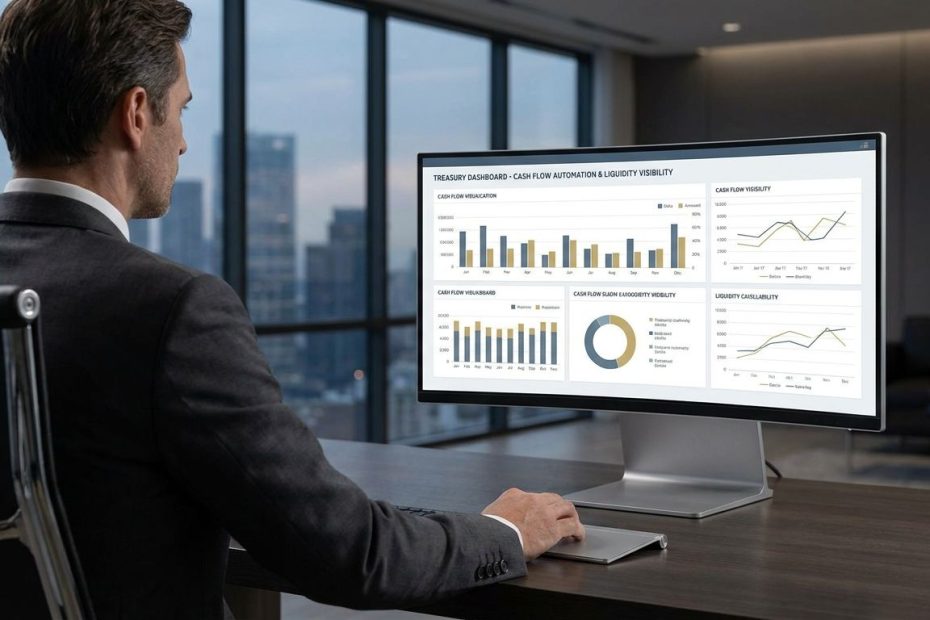
Treasury management technology helps a Chief Financial Officer (CFO) automate cash flow, improve liquidity visibility, reduce manual work, and make faster funding decisions. The real value comes when your treasury data moves from scattered spreadsheets and bank portals into one connected operating model.
If you’re still relying on daily file downloads, manual cash reports, and forecast updates from multiple teams, your treasury function is probably slower than the business needs it to be. This guide shows how to evaluate Treasury Management System (TMS) platforms, bank connectivity, Artificial Intelligence (AI), Machine Learning (ML), and automation tools so you can modernize cash and liquidity management without losing control.
Why Treasury Automation Is Now A CFO Imperative
Cash is no longer something you review after the month closes. You need timely visibility into balances, borrowing needs, investment capacity, currency exposure, and working capital pressure. Treasury management technology gives you a faster way to see where cash sits, how it’s moving, and what decisions you need to make before liquidity gets tight.
The pressure is practical, not theoretical. The Association for Financial Professionals reports that inaccurate cash forecasts remain a major challenge for many organizations, and Deloitte found that many treasury teams still lack full visibility into global cash positions. When your data arrives late or in different formats, you spend too much time reconciling yesterday’s numbers instead of acting on today’s risk.
For a CFO, automation changes treasury from a reporting function into a decision engine. You can compare cash needs across entities, reduce idle balances, evaluate funding choices, and spot liquidity gaps sooner. That matters for mid-market companies as much as global enterprises, because limited treasury staff often carry the same operational burden with fewer tools.
The Hidden Costs Of Manual Cash And Liquidity Management
Manual treasury work looks inexpensive until you measure the time, errors, delays, and missed decisions behind it. Spreadsheets give you flexibility, but they also create version-control problems, formula risk, and slow consolidation. When different teams update different files, your cash position becomes a negotiated number instead of a reliable operating fact.
Fragmented bank access adds another cost. Your team may log into several portals, download reports, convert file formats, and manually classify transactions before you can answer a basic question: how much cash is available now? That delay affects debt repayment, short-term investing, supplier payments, and internal funding.
The cost also shows up in working capital. If you don’t trust the forecast, you hold extra cash as a cushion, borrow earlier than needed, or delay investment decisions. A modern TMS can reduce those buffers by improving cash forecasting automation, bank reporting, and liquidity planning across business units.
Core Technologies Powering Modern Treasury Management Technology
A modern treasury stack usually starts with a Treasury Management System (TMS). The TMS acts as the central workspace for cash positioning, bank reporting, payments, liquidity planning, debt tracking, investment tracking, and risk management. It replaces scattered tools with controlled workflows, standardized data, and repeatable processes.
Application Programming Interface (API) connectivity is becoming a major part of treasury modernization. Instead of waiting for batch files, APIs can support faster balance and transaction updates between banks, Enterprise Resource Planning (ERP) systems, and treasury platforms. PwC notes that APIs are replacing older host-to-host methods in many treasury operations, especially where real-time data access is a priority.
Robotic Process Automation (RPA), Artificial Intelligence (AI), and Machine Learning (ML) add another layer. Robotic Process Automation can handle rules-based work like data extraction and report preparation. Artificial Intelligence and Machine Learning can support pattern detection, short-term forecast improvements, scenario modeling, and exception alerts, as long as your source data is clean and your controls are well designed.
Building The Business Case For Return On Investment
Your business case should connect treasury automation to measurable financial outcomes. Start with labor savings, but don’t stop there. The stronger case usually includes forecast accuracy, reduced borrowing costs, better cash deployment, risk control, fewer payment errors, and faster month-end or daily reporting.
Use current process data to set a baseline. Measure how many hours your team spends collecting bank data, updating forecasts, reconciling cash, preparing reports, approving payments, and fixing errors. Then compare that baseline against the expected operating model after automation, including staff time redirected toward analysis and decision support.
Vendor materials from Kyriba and GTreasury point to large gains in forecast efficiency and accuracy when companies replace spreadsheet-heavy processes with automated forecasting tools. McKinsey also reports that advanced analytics can improve cash-flow forecasting accuracy and reduce working capital needs. Treat those figures as directional benchmarks, then build your own Return on Investment (ROI) model using your bank count, entity count, transaction volume, borrowing rates, and treasury staffing levels.
Key Capabilities CFOs Should Demand In A Treasury Platform
Real-time or near-real-time cash visibility should sit at the top of your requirements list. You need one view of balances across banks, entities, regions, and currencies, with the ability to drill into transactions and exceptions. Without that visibility, every other treasury decision starts with uncertainty.
Cash forecasting automation is the next priority. Look for tools that can combine bank transactions, Enterprise Resource Planning data, accounts receivable, accounts payable, payroll, debt schedules, tax payments, and business-unit inputs. A useful platform should support multiple forecast horizons, variance analysis, forecast ownership, and audit trails so you can see why forecasts changed.
Your platform should also support multi-currency cash management, payment controls, bank fee analysis, debt and investment tracking, Foreign Exchange (FX) exposure management, and interest-rate scenario analysis. Security matters as much as functionality. Role-based access, approval workflows, payment screening tools, encryption, and strong audit logs help you automate without weakening financial control.
Overcoming Integration Hurdles With Enterprise Resource Planning, Banks, And Legacy Systems
Integration is where many treasury projects slow down. Your banks may use different formats, your Enterprise Resource Planning system may have custom fields, and your chart of accounts may vary across entities. Before selecting a platform, map the data you need, where it comes from, how often it updates, and who owns it.
A phased rollout reduces risk. Start with bank connectivity and cash visibility, then add forecasting, payments, risk modules, and advanced analytics. This lets your treasury team prove value early while your information technology and finance teams work through deeper integrations.
Middleware and cloud-native platforms can help connect older systems with newer treasury tools. The goal is not to replace every process at once. The goal is to build reliable data flows, reduce manual file handling, and create one controlled source for treasury decisions.
Implementing Automation With A Practical CFO Roadmap
Start with a treasury process assessment. List your banks, accounts, entities, currencies, payment types, reporting deadlines, system owners, manual workarounds, and recurring pain points. Then rank the pain points by financial exposure, time spent, risk level, and impact on decision speed.
Vendor selection should focus on fit, not feature volume. Compare platforms based on bank connectivity, Enterprise Resource Planning integration, forecasting logic, payment controls, security model, implementation support, scalability, and ease of use. Ask vendors to demonstrate your real workflows instead of generic product tours.
Run a pilot with a defined scope. Cash positioning across priority banks is often a strong starting point because it produces visible benefits quickly. After the pilot, refine your data rules, train users, update approval workflows, and expand into forecasting, payments, liquidity planning, and risk reporting.
Managing Risk Without Slowing Down The Treasury Team
Automation should reduce risk, not create new blind spots. A well-designed treasury platform helps you standardize approvals, separate duties, monitor exceptions, and keep a clear audit trail. That’s especially useful when payment volumes rise or treasury staff manage multiple entities across time zones.
Cyber risk deserves direct attention during platform selection. Review authentication methods, user permissions, encryption standards, bank communication methods, and vendor security documentation. Your finance, treasury, information technology, and risk teams should agree on control requirements before implementation starts.
Market risk also belongs in the technology discussion. Treasury platforms can support Foreign Exchange exposure tracking, debt reporting, interest-rate scenario planning, and hedge documentation workflows. You still need judgment, policy, and review discipline, but the system gives you cleaner data and faster alerts.
The Future Of Treasury Technology CFOs Should Watch
Instant payments are changing daily cash operations. Faster payment rails can improve settlement speed, but they also require stronger controls, real-time monitoring, and better liquidity planning. If money moves faster, your visibility and approval workflows need to keep pace.
Artificial Intelligence and Machine Learning will keep improving treasury forecasting and scenario planning. These tools are most useful when they support human review rather than replacing it. You should expect better anomaly detection, cash-flow pattern recognition, and forecast variance explanations as treasury platforms mature.
The strongest CFOs will use treasury management technology as part of a broader finance operating model. Cash data should connect with working capital, procurement, sales planning, debt strategy, and investment choices. When treasury data flows cleanly across finance, liquidity becomes a planning advantage rather than a reporting burden.
What Is The Return On Investment Of Automating Treasury Management?
- Lower manual treasury effort
- Better cash forecast accuracy
- Faster liquidity decisions
- Reduced borrowing pressure
- Stronger payment controls
Turning Treasury From Reporting Work Into Decision Power
Treasury automation works best when you treat it as an operating upgrade, not a software purchase. Start with the cash and liquidity decisions you need to make faster, then choose technology that improves data quality, visibility, controls, and forecasting. A Treasury Management System, strong bank connectivity, and smart automation can reduce manual work while giving you better command of funding, risk, and working capital. For a CFO, the payoff is practical: fewer delays, cleaner decisions, and a treasury team that spends more time steering cash than chasing it.